 damian_site
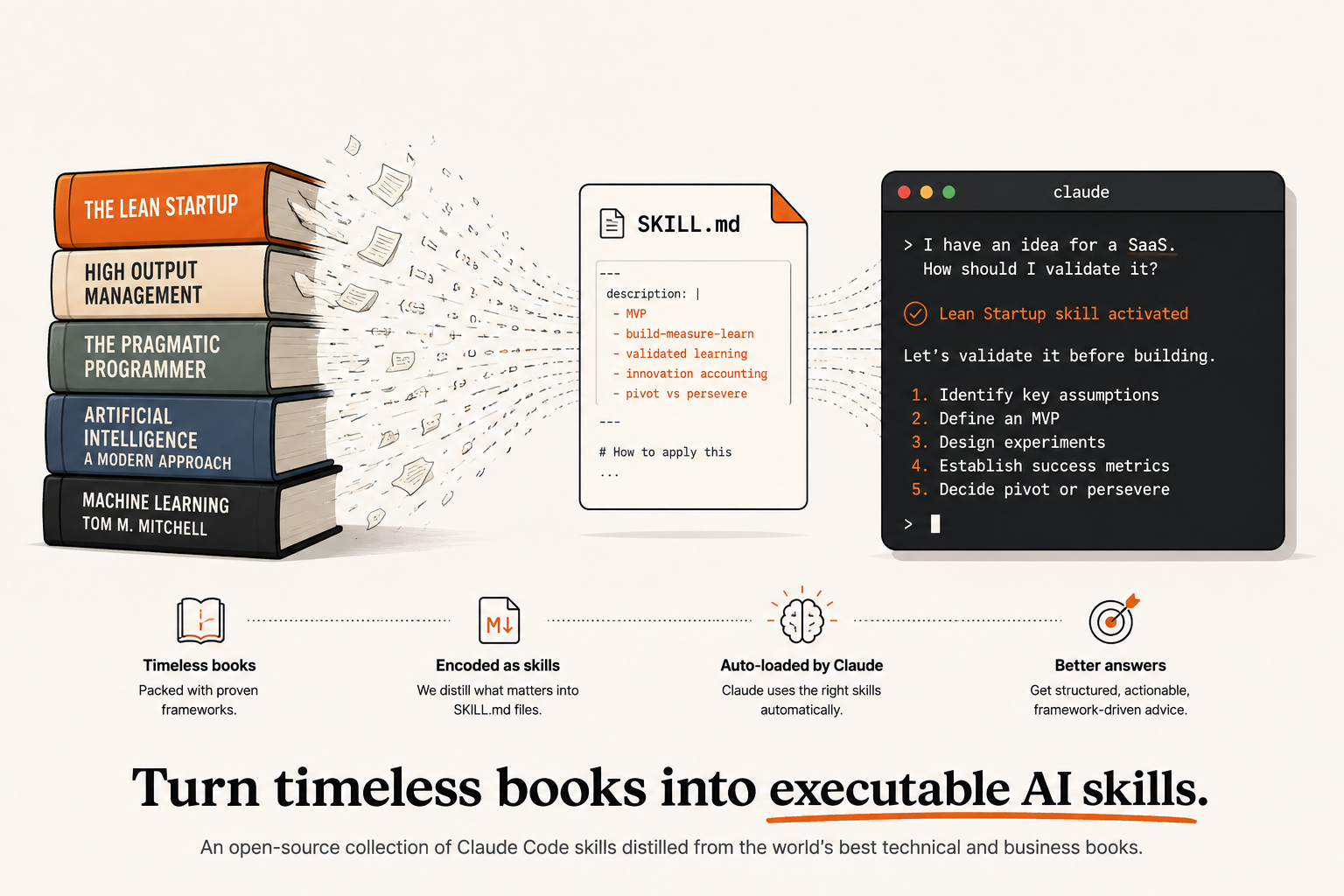
I just open-sourced book-skills: a Claude Code skill for each of my favorite books, so Claude applies that book’s framework automatically the moment a conversation calls for it — no need to say the title out loud.
I’ve been listening to Lenny’s Podcast latest episode with Dianne Penn, Head of Product for Research & Labs at Anthropic, and one thing she said stuck with me: she’d built herself a set of Claude Code skills based on the management and product books that shaped how she works, so Claude applies that thinking automatically instead of her having to re-explain it every time.
That reminded me of Marc Andreessen’s line about only reading books that are at least ten years old — the ones that have already proven durable. So I picked books I’d apply that filter to myself, and turned them into skills:
👉 github.com/DamiMartinez/book-skills
It’s public, MIT-licensed, and open to anyone who wants to add a skill for their own field.
What this actually is
A Claude Code skill is a folder with a SKILL.md file: some frontmatter plus instructions that Claude loads only when it’s relevant to what you’re doing. book-skills is a collection of these, one per book — each one packaging that book’s core framework so Claude applies it automatically whenever the ideas come up, not just when you say the title.
Concretely: with the lean-startup skill installed, saying “help me plan this new feature, I want a lean approach” or “how do I validate this before building it” makes Claude structure its answer around Build-Measure-Learn, MVPs, and actionable metrics — no need to say “use the lean startup skill.”
How triggering works
Claude Code decides whether to use a skill by matching what you’re asking against that skill’s description field. That’s the whole mechanism — so a good skill description front-loads the book’s actual terminology (validated learning, MVP, wartime CEO, pointer arithmetic) instead of just restating the title. You don’t need to name the book; mentioning its concepts is enough. And skills only kick in for tasks substantial enough to benefit — a trivial one-off question won’t necessarily trigger one, even if it’s topically related.
What’s inside
Eight skills so far, spanning product, leadership, and engineering:
| Skill | Book | Topic |
|---|---|---|
lean-startup |
The Lean Startup — Eric Ries | MVP, Build-Measure-Learn, validated learning, pivot vs. persevere |
high-output-management |
High Output Management — Andrew S. Grove | Managerial leverage, task-relevant maturity, one-on-ones, decision-making |
hard-thing-about-hard-things |
The Hard Thing About Hard Things — Ben Horowitz | Wartime/peacetime CEO, no-easy-answers decisions, firing/layoffs |
pragmatic-programmer |
The Pragmatic Programmer, 20th Anniversary Ed. — Hunt & Thomas | DRY, orthogonality, coupling, Design by Contract, refactoring |
ai-modern-approach |
Artificial Intelligence: A Modern Approach — Russell & Norvig | PEAS, agent architectures, search, CSPs, Bayesian networks, MDPs |
machine-learning-mitchell |
Machine Learning — Tom M. Mitchell | Bias-variance, evaluation methodology, MAP/naive Bayes, PAC learning |
c-programming-language |
The C Programming Language, 2nd Ed. — Kernighan & Ritchie | Pointer arithmetic, declaration reading, manual memory ownership |
automate-boring-stuff |
Automate the Boring Stuff with Python — Al Sweigart | File ops, CSV/Excel/PDF handling, web scraping, safe automation |
More are coming — product management, design patterns, system architecture, data engineering — see the repo’s contributing section.
Anatomy of a skill
Every SKILL.md in the repo follows the same shape. Here’s lean-startup, trimmed:
---
name: lean-startup
description: Applies Eric Ries's "The Lean Startup" framework (Build-Measure-Learn
  loop, validated learning, MVP, innovation accounting, pivot vs. persevere,
  actionable vs. vanity metrics, five whys, small batches, split testing) to plan
  or evaluate a feature, product, or business idea. Use this skill whenever the
  user wants a "lean startup approach," mentions "validated learning," "MVP,"
  "minimum viable product," "build-measure-learn," "pivot," "innovation
  accounting," or asks how to test a risky assumption before building something
  fully — even if they don't say "lean startup" by name.
---

# The Lean Startup

## Core concepts

**Leap-of-faith assumptions** — Every new idea rests on assumptions that could
be wrong: the value hypothesis and the growth hypothesis. Identify these
explicitly before proposing a build plan.

**MVP (Minimum Viable Product)** — Not a smaller/crappier version of the final
product. It's the smallest experiment that generates validated learning about
a leap-of-faith assumption, with the least effort.

...

## How to apply this

1. State the leap-of-faith assumptions.
2. Rank assumptions by risk — test the riskiest one first.
3. Design the smallest MVP that produces evidence on it.
4. Define the actionable metric(s) — and what counts as failure.
5. Set a pivot/persevere checkpoint.
Three sections, always: frontmatter with a keyword-dense description, a Core concepts list (8-13 ideas that are actually actionable, not a book report), and a How to apply this procedure describing how Claude should structure its response when the skill fires.
Installing it
Skills are just folders. Clone the repo, then symlink the ones you want:
git clone https://github.com/DamiMartinez/book-skills.git

# Global — available in every Claude Code session
ln -s "$(pwd)/book-skills/skills/lean-startup" ~/.claude/skills/lean-startup

# Or install all of them at once
for skill in book-skills/skills/*/; do
  name=$(basename "$skill")
  [ "$name" = "_template" ] && continue
  ln -s "$(pwd)/$skill" ~/.claude/skills/"$name"
done
Symlinking (rather than copying) means every skill stays current with a git pull. No restart needed — Claude Code picks them up at the start of a session.
Contributing
The repo ships a _template folder for exactly this. Adding a skill for a book that shaped how you work:
cp -r skills/_template skills/<book-slug>- Fill in
SKILL.md— adescriptionlisting the book’s actual key terms (this is what drives triggering), 3-8 genuinely actionable Core concepts, and concrete How to apply this steps. - Test it in a real conversation and tune the description if it doesn’t trigger.
- Update the README table and open a PR.
Keep it focused on what’s actionable from the book, not exhaustive coverage of it — that’s the whole design philosophy.
Why this matters
Dianne Penn built these for herself, privately, to speed up her own PM work. That’s really the whole point of this repo — instead of every engineer, PM, or manager re-deriving the same lessons from The Lean Startup or High Output Management on their own, the framework just sits there as a skill, ready the moment the conversation needs it.
If you’ve got a book you keep mentally reapplying at work, I’d genuinely like a PR for it.
Like this content? Subscribe to my newsletter to receive more tips and tutorials about AI, Data Engineering, and automation.